
Leadership framework · Kingdom Rochambeau
What Your Strength Makes Possible for Someone Else
How vision, present craft, and proven strength can become an exchange of encouragement, honor, and contribution.

A company can contain a great deal of talent and still spend most of its energy keeping that talent from inconveniencing anyone with authority.
The person who sees a new possibility leaves the meeting exasperated. The person responsible for delivering this month's work leaves with another impractical assignment. The person who built the business leaves wondering why success has apparently made him the person his colleagues are least willing to hear.
Everybody has evidence. Nobody feels heard. The meeting has produced several privately satisfying speeches that will be delivered in the car.
Kingdom Rochambeau is a framework I use to examine this kind of exchange. It begins with three ways people find confidence in their work, then asks what they give and receive when those ways meet. The purpose is to make our strengths more available to one another. A correct personality label would be a rather small consolation for another wasted Tuesday.
Three places to stand
Some people take their confidence from proven ground. Something has been built. It has endured difficulty, paid wages, served customers, and demonstrated that certain choices work. I call this orientation Builder. A Builder's history provides evidence and includes responsibilities. The person knows what it took to get here and may have paid costs the others have forgotten.
Other people take confidence from present reality. They know what the equipment can do, what the customer requested, which commitment is slipping, and what must happen next. I call this orientation Operator. Their gift includes making the possible executable. They live close enough to the work to know when a wonderful sentence conceals an impossible Thursday.
Others find their confidence in a future they can see. The present arrangement is one expression of what might be, and perhaps an inadequate one. They notice meaning, possibility, a neglected purpose, or a different way the pieces could fit. I call this orientation Architect.
These are starting points for understanding someone's reasoning. Job titles will not do the work for us. A founder can speak from any of these orientations. The person maintaining a process may be the clearest Architect in the business. Listen to the grounds of a person's confidence before deciding what they bring.
The framework is a practical, non-scientific aid to that listening. People vary by situation, and the person gets to correct our reading. We are trying to understand a colleague, which is already a sufficiently ambitious project.
How each frame can win
Rochambeau is another name for rock-paper-scissors. In the familiar game, each move defeats one move and loses to another. Something similar can happen when these strengths become ways to defend ourselves.
The Builder can overrule the Operator's present evidence with established power: we have done this successfully for years, and we will keep doing it. The Operator can defeat the Architect's future with present constraints: show how it works with the people, money, and time we actually have. The Architect can defeat the Builder's settled arrangement by questioning its purpose: what does all this success amount to if we have lost what we meant to accomplish?
Any of those objections may contain truth. The problem is the use of a frame to dispose of the other person and the truth in that person’s objection. Winning the exchange does not establish that the business has learned anything.
Consider a hypothetical proposal for improving customer onboarding. The Architect sees a more generous experience. The Operator knows the current team cannot deliver the proposed promises. The Builder has paid for previous improvements and doubts this one will produce a return.
A protective exchange makes each concern a weapon. The Architect implies the others do not care about customers. The Operator makes the idea look foolish. The Builder ends the discussion. The company keeps the old process, along with three refreshed grievances.
The unused possibility and the avoided mistake both deserve consideration.
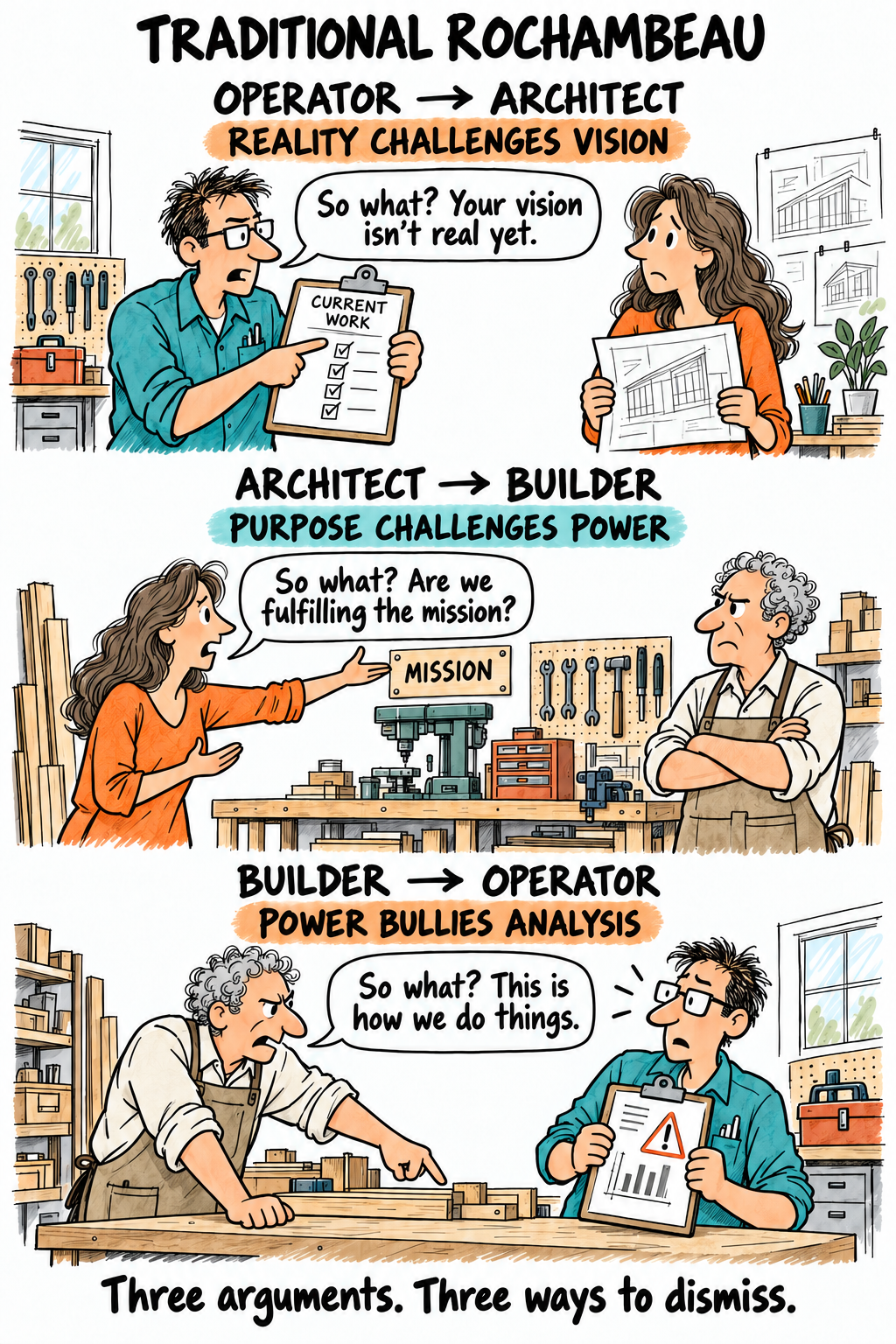
Traditional Rochambeau: using “So what?” to challenge and dismiss another perspective.
 Open full-size illustration
Read the illustration as text
Traditional Rochambeau. Three imagined workshop exchanges adapt Pete Gall’s explanation of using ‘So what?’ to dismiss another person’s perspective. Operator to Architect—reality challenges vision: the Operator points to current work and says, ‘So what? Your vision isn’t real yet.’ Architect to Builder—purpose challenges power: the Architect points to the mission and says, ‘So what? Are we fulfilling the mission?’ Builder to Operator—power bullies analysis: the Builder overrides the Operator’s warning and says, ‘So what? This is how we do things.’ The closing line reads, ‘Three arguments. Three ways to dismiss.’ The scenes show present reality challenging a future proposal, purpose challenging established practice, and authority overriding analysis. Each claim still needs to be examined on its merits; dismissing a person and defeating their argument are different outcomes.
Reversing the exchange
The Kingdom movement in this framework changes the direction of giving and receiving.
The Architect gives encouragement to the Operator: a recognizable reason the present work matters, a future worth contributing to, and help seeing how today's effort belongs in it. Encouragement owes the worker something more substantial than enthusiasm about work the encourager will never have to do.
The Operator gives honor and gratitude to the Builder: specific recognition of what has been made possible through risk, accumulated judgment, and provision. Honest honor can coexist with a request to change something. It need not purchase agreement or flatter the person controlling the budget.
The Builder contributes to the Architect: resources, access, experience, permission, or practical support that helps a promising future become real. A contributor can set wise limits. It becomes less generous when the price of support is surrendering the very possibility the Architect brought.
This is a natural cycle of blessing, rather than an exclusive directory of who may help whom. Builders can encourage Operators. Architects can honor Builders. People with similar orientations can serve each other beautifully. The cycle helps us notice forms of giving and receiving that our habitual arguments may obscure.
Receiving deserves particular attention. A Builder who cannot receive thanks may keep demanding proof that people appreciate the sacrifice. An Architect who cannot receive contribution without anticipating control may remain isolated with an excellent idea. An Operator who distrusts all encouragement may be left alone with the tasks and no believable reason to keep caring.
Generosity needs somewhere to arrive.
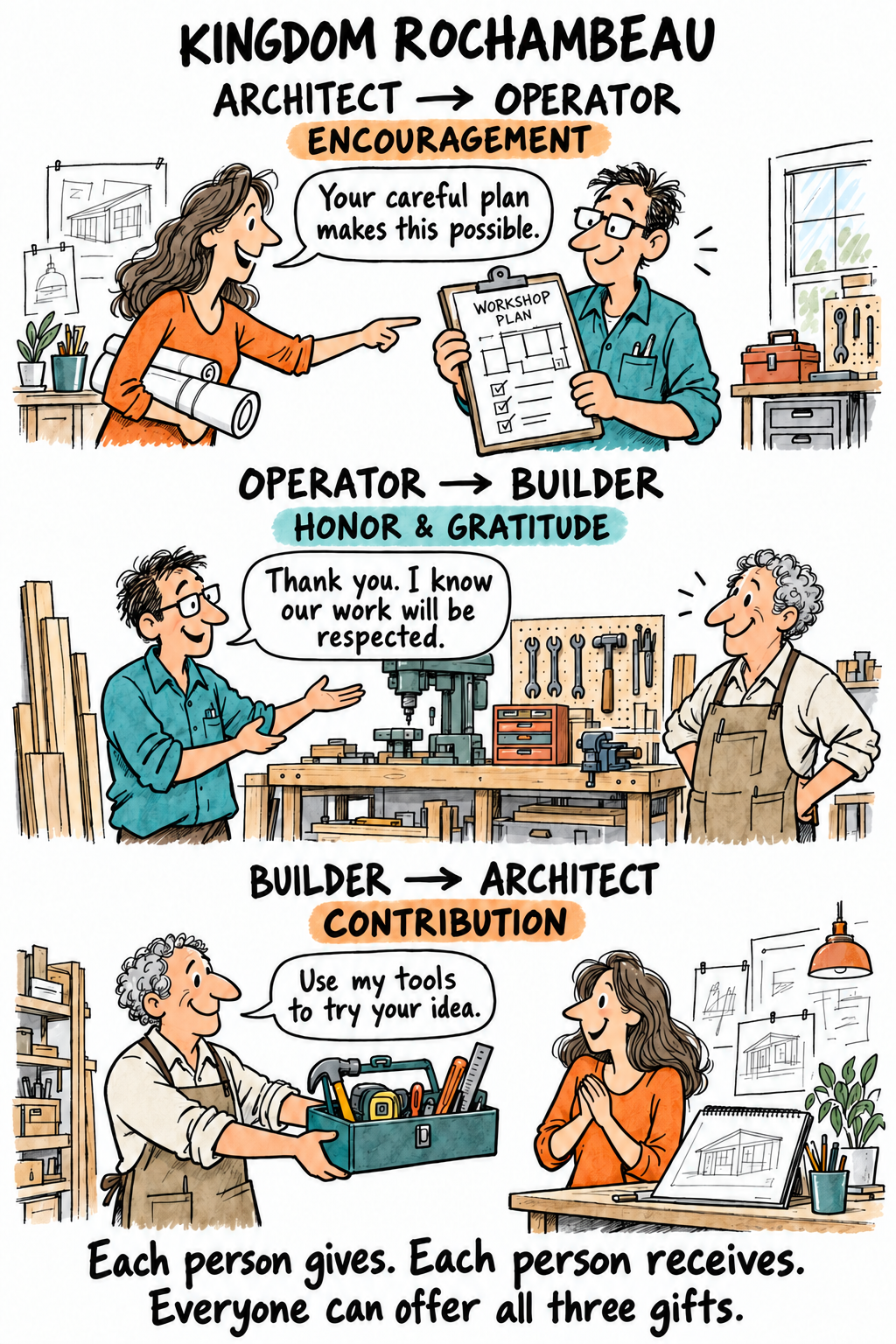
Kingdom Rochambeau: encouragement, honor, and contribution support one another.
 Open full-size illustration
Read the illustration as text
Kingdom Rochambeau. Three imagined workshop exchanges show giving and receiving. Architect to Operator—encouragement: the Architect recognizes a careful workshop plan and says, ‘Your careful plan makes this possible.’ Operator to Builder—honor and gratitude: the Operator says, ‘Thank you. I know our work will be respected.’ That gratitude recognizes stable, trustworthy conditions in which diligent effort can be offered with confidence it will not be squandered or abused. Builder to Architect—contribution: the Builder offers tools for the Architect’s proposed workshop and says, ‘Use my tools to try your idea.’ The closing lines read, ‘Each person gives. Each person receives. Everyone can offer all three gifts.’ Architect, Operator, and Builder describe ways of finding grounds for hope. These are natural affinities; people can give and receive all three gifts, including with someone of the same orientation. Encouragement names something real, honor recognizes actual contribution, and practical help supports the recipient’s purpose and agency.
Put the cost back in the picture
Return to the onboarding proposal. The Architect could begin by listening to what the Operator wants to make better, then connect the proposed change to those actual concerns. The Operator could acknowledge the Builder's previous investment and explain exactly where the current process creates avoidable work. The Builder could support a bounded experiment, supply what it needs, and remain open to learning from the people doing it.
The experiment may reveal that the idea is wrong. The team may lack capacity. The Builder may reasonably decline. A healthy exchange can produce a useful no and leave the people more able to work together.
Ask who chooses, who contributes, who does the work, and who receives the benefit. If one person's beautiful vision depends on someone else's unacknowledged exhaustion, the language of generosity has outrun the relationship. If the generous offer makes refusal impossible, look again at the offer.
The same scrutiny applies to success. Revenue, applause, and a completed project tell us something important. They do not by themselves tell us whether the people involved have been strengthened or used up.
For a Christian leader, authority is an opportunity to participate in God's care for particular people. That includes people whose gifts make them inconvenient. Their difference may be precisely the part of the work we cannot supply alone.
A different next meeting
Choose one recurring disagreement. Ask each person what gives them confidence and what makes them hesitant. Keep their actual words. An answer about present constraints may be a responsible observation, rather than evidence that someone lacks vision.
Then look for one contribution that does not require the other person to become more like you. Offer encouragement with a basis. Name an actual contribution with gratitude. Put a resource behind a possibility you have taken time to understand. Allow the recipient to say what would help.
You may find that the strength you have been defending is still needed. It can remain strong while becoming easier to receive.
The more interesting question is what that strength now makes possible for somebody else.
For the fuller exploration, read Kingdom Rochambeau.
Written with AI drafting assistance.