
Leadership framework · Valence–Arousal
When Being Right Is Part of the Job

A leadership treatment of holding standards and people in view when responsibility requires a difficult decision.

Authority puts a peculiar strain on love. You may care deeply about someone and still have to tell him that the work is unacceptable, that the money is gone, or that he cannot continue in a role he wants to keep. You have other people to answer for. Their livelihoods and trust belong in the conversation too.
A leader who refuses those decisions can do considerable damage while feeling kind. A leader who enjoys them can do considerable damage while being correct.
That leaves us with an awkward assignment: hold the standard and the person in view at the same time, even when doing so makes the decision harder. Especially then. Being responsible for an organization gives us consequential work to do. It also gives us unusually respectable ways to stop seeing people.
I use a framework called Valence-Arousal to look at what happens in that strain. The name sounds like something that should arrive with electrodes. My adaptation is a practical way to ask which good we are protecting, and what we do when another good gets in its way.
The organizing question is right relationship. What would it mean for truth and love to remain fully consequential in this particular decision?
 Open full-size illustration
Read the illustration as text
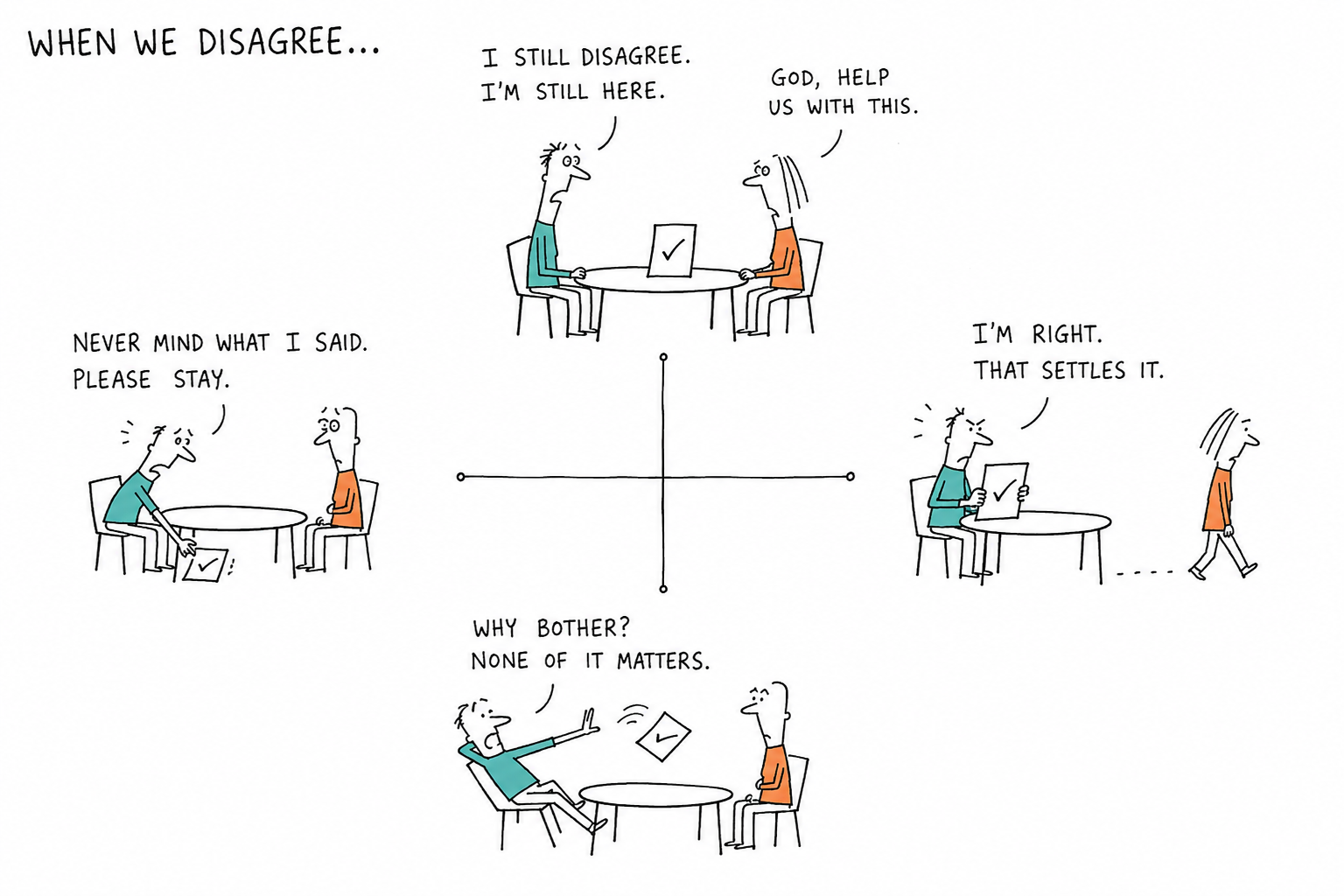
When we disagree: at the top, two people remain at a table with their conviction still present. One says, “I still disagree. I’m still here.” The other says, “God, help us with this.” At the left, someone puts conviction aside: “Never mind what I said. Please stay.” At the right, someone keeps the claim while the other person leaves: “I’m right. That settles it.” At the bottom, someone dismisses both the claim and the conversation: “Why bother? None of it matters.” These scenes illustrate responses we can move between, not fixed personalities or measured scores. The invitation is to keep right and relationship consequential and entrust unresolved tension to God.
The relief of a clean answer
Imagine a department head who has missed another commitment. This is a hypothetical case, although the meeting will probably feel familiar. The owner has covered for him before. Colleagues are tired of absorbing the unfinished work. There are personal circumstances, real ones, and the owner is tired of hearing about those too.
One available answer is clean: the standard was known, the standard was missed, and the consequence follows. There can be considerable wisdom in that answer. Consistency protects the people who otherwise pay for someone else's exceptions.
The question is what the clean answer permits the owner to stop considering. Does the failure become the whole description of the employee? Does the explanation become an excuse before anyone has heard it? Does accountability quietly grant permission for contempt?
On one side of this framework, certainty becomes the organizing good. The lines are firm. The decision is defensible. The person on the other side of the line can disappear from our care without making the paperwork untidy.
Another answer protects the relationship by relaxing the standard. The owner makes another exception, softens what was agreed, and asks everyone to be understanding. Again, mercy may be exactly what the moment requires. An exception can be responsible and explicit. But an unspoken exception has a habit of sending an invoice to the people who still have to deliver.
On this side, the relief comes from avoiding a rupture. The conversation feels kinder because the conflict has been postponed or the disputed obligation has lost its force. We may have protected one relationship by making several others less truthful.
Justice and mercy both belong here. The trouble starts when one is used to relieve us of the other.
The executive version of giving up
There is a third way out. Decide that the whole thing is theater. People disappoint you. Values statements are decoration. Everybody protects an interest, so the sensible person quits taking the stated ideals seriously.
This can sound worldly and experienced. It can also sound furious. The person who has decided nothing matters may have quite a lot to say about it.
In this framework, calmness does not establish maturity, and intensity does not establish care. A quiet executive can be carrying a terrible responsibility faithfully. A quiet executive can also have stopped caring. We need to look at what remains at stake for the person, rather than treating tone as a spiritual weather report.
The cynical move reduces the cost of leadership by reducing what leadership means. We still hold meetings and hit targets, but we have withdrawn our hope from the people doing the work. Their growth, their dignity, and the possibility of repair become sentimental distractions from the real business.
It is difficult to invite people into meaningful work while privately considering meaning a management device.
Carrying a decision without owning the whole solution
The direction I want to practice keeps the claims of truth and relationship alive together. It may require a firm consequence. It may require an exception. It will require looking more closely than our preferred answer usually demands.
For the owner in our example, that could mean removing the department head from his role while speaking accurately about his contribution, keeping appropriate personal information private, and helping him understand the decision without turning the meeting into a prosecution of his worth. The owner would also need to acknowledge the colleagues who carried the missed work. They are people in this story.
Perhaps a different set of facts calls for a defined period of support and a revised agreement. That response would need clear obligations, honest capacity, and the consent of those carrying the additional load. Calling something compassionate does not supply the hours needed to do it.
The framework does not select the correct personnel decision. It helps expose what our selection is costing, whom we have stopped considering, and which part of the tension we are trying to make disappear.
For a Christian leader, this becomes a question of lordship. We remain answerable for the decisions entrusted to us, and we bring to God the remainder we cannot resolve. We ask for wisdom, for the courage to act, for correction, and for a good future for people whose choices we cannot control.
Prayer can hold the people whom our decision cannot hold in the same arrangement. It should also leave us available to discover that our decision needs correcting.
The chart is a mirror
The horizontal movement in my framework concerns the good around which we organize: certainty and justice on one side, subjective validation and mercy on the other. The vertical movement concerns what we do with the tension. In one direction, we accept more of its burden while keeping right and relationship consequential. In the other, we deny enough of the stakes to make the burden easier to dismiss.
These are interpretive directions. They are not calibrated measures of emotion or employee assessments. A person can move among them in the course of one difficult afternoon. Anyone who has answered an email too quickly should find that plausible.
The useful first application is to the person making the judgment. Before asking where an employee belongs on the chart, ask what your own preferred response buys you. Relief? Approval? A reputation for decisiveness? Freedom from another conversation?
Then consider the room. Who can disagree without paying an unreasonable price? Who will carry the practical cost of an exception? Who is being described entirely by a failure? What would still be true if the person telling the story were someone you disliked?
Those questions can slow a decision. They can also keep a fast decision from becoming a long injury.
A place to begin
Take one unresolved leadership decision. Write down the standard or conviction that deserves protection. Then name the people whose good also remains your concern, including those who are easy to leave off the list.
Consider a response that keeps both entries consequential. Be specific about the boundary, the help, the cost, and what you still do not know. There may be no version that leaves everyone pleased. Right relationship asks more of us than a pleasant meeting.
Bring that unfinished work to God before turning it into a verdict about the people involved. You may still have to deliver the hard news. You may need to hear some yourself.
The hope is that responsibility can deepen our love instead of gradually replacing it. That is worth staying in the room for.
For the fuller exploration, read Valence–Arousal.
Written with AI drafting assistance.