
Leadership framework · Three Economies
What a Company Can Promise a Person

Examine what employment, family belonging, and spiritual life each promise a person.

When a company says it is a family, it is making a very large promise. Larger, usually, than the person writing the careers page has considered.
A family gives you a place that exceeds your current usefulness. An employment relationship contains obligations that can end when the work no longer requires your role, or when either party can no longer keep the agreement. Both relationships can be honorable. Trouble begins when the language of one is used to enlarge the claims of the other.
An employee can hear belonging where an employer means commitment. An owner can hear loyalty where an employee means a fair exchange. They may work together for years before discovering that they have been answering different offers.
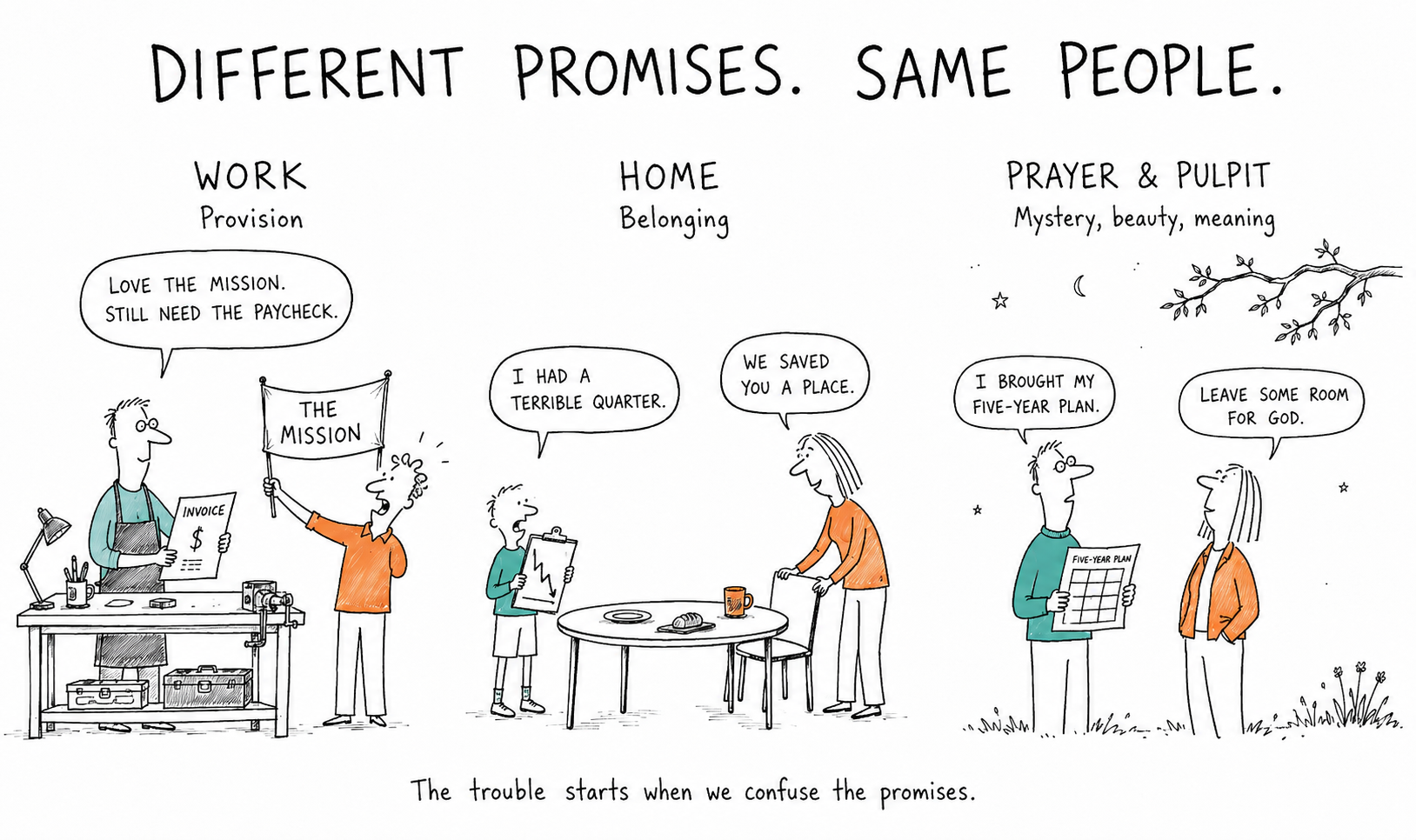
I use three economies to help examine these crossed expectations: home, work, and prayer & pulpit. An economy here describes what a relationship is being asked to provide and how people understand their obligations within it. It gives us a way to ask a question that a slogan cannot settle: what have we actually promised one another?
 Open full-size illustration
Read the illustration as text
Different promises. Same people. Work—Provision: a worker holding an invoice says, “Love the mission. Still need the paycheck.” Home—Belonging: a child with a performance chart says, “I had a terrible quarter.” A parent replies, “We saved you a place.” Prayer and pulpit—Mystery, beauty, meaning: beneath an open sky, one person says, “I brought my five-year plan.” Another replies, “Leave some room for God.” The closing observation is, “The trouble starts when we confuse the promises.” These are kinds of relationship, not exclusive buildings or roles. Meaningful work can include belonging, and ministry employment still carries work agreements. Openness to God does not prohibit planning.
Work has a good of its own
The work economy concerns provision. People enter agreements, take roles, supply value, and receive recompense. A business makes promises to customers, employees, investors, suppliers, and the people who depend on all of them. Keeping those promises requires attention to capacity, money, and performance.
There is dignity in this. Paying someone accurately and on time can be a substantial expression of care. Making a useful product can serve people whose names you will never learn. A reliable job can help a person provide for their family and pursue interests beyond work.
Owners sometimes speak as though the transactional part of work is the regrettable part, the thing a sufficiently inspiring mission might help everyone rise above. Yet the transaction is where several of our most important promises become specific. The wage, the hours, the agreed responsibility, and the customer's purchase all make claims that enthusiasm cannot fulfill by itself.
A company can offer purpose, friendship, formation, and belonging. Those goods become more credible when the work agreement is truthful. They become suspect when they are brought forward whenever the company wants more than it has agreed to give.
The language of family should never have to explain a missing paycheck.
Home asks a different question
The home economy concerns belonging. A person has a place in relationships that extends beyond performance. The child who fails still belongs. The elderly parent who can no longer contribute still belongs. There are responsibilities, boundaries, and difficult decisions inside that belonging. Its value cannot be reduced to what a person produces this quarter.
The difference matters for business leaders because success can train us to trust the tools that made success possible. We set a target, clarify ownership, measure results, and address a miss. Then we arrive home, where a tired human being may have made the administrative error of wanting us rather than a solution.
Care can include practical help. Families need provision. But a household can feel increasingly like a poorly managed department if belonging becomes conditional on achievement, improvement, or agreement with the person supplying the money.
The reverse transfer happens too. An employee may reasonably value the friendships and history of a company, yet expect those relationships to guarantee a role that the organization can no longer sustain. That disappointment deserves care. It also calls for honesty about what was promised, including what the employer encouraged the person to believe.
The framework asks us to examine both sides of the expectation. It gives neither party an automatic defense.
The part that will not fit in a contract
Prayer & pulpit names the economy of mystery, beauty, conviction, and meaning. It concerns the questions that remain after a person has adequate provision and a place to belong. What is this life for? What deserves devotion? What is God inviting us to notice or become?
Those questions can disturb a well-run business. They can disturb a well-run church too. Meaning has an inconvenient habit of asking whether the arrangement is worthy of the people maintaining it.
In this economy, a person may discover a purpose that changes how they approach work. They may also place an impossible demand on work: every task must affirm their deepest identity, every decision must express the whole of their calling, every colleague must share their sense of significance.
Some necessary work is simply necessary. It can contribute to a meaningful life while other relationships and activities also give that life meaning. Someone still needs to reconcile the invoice. The invoice is unlikely to develop a rich inner life while waiting.
Christian employers have particular reason to be careful here. Shared faith can deepen care and purpose, but it can also make a practical request feel like a test of someone's devotion to God. An employee should be able to ask about hours, compensation, workload, and authority without having the question converted into a spiritual deficiency.
The employment agreement remains real in a Christian company.
The same people, different relationships
These are relationships to understand, rather than compartments in which to seal people. A company may be run by a family. A church has employees. A friendship may become a business partnership. The same two people may belong to several economies at once.
Consider a hypothetical owner whose adult daughter works in the company. Her role is underperforming, and the owner delays a necessary conversation because a job decision feels like a verdict on fatherhood. The daughter, meanwhile, cannot tell whether criticism concerns her work or her place in the family.
Naming the relationships separately can help. The employment role needs clear expectations and an honest decision. The family relationship needs an explicit assurance of belonging, expressed in ways that do not depend on the job continuing. The owner's prayer may need to include the grief of discovering that these obligations cannot be satisfied with one gesture.
No framework removes that difficulty. It can keep us from sending one relationship to do work that belongs to another.
For a nonfamily employee, the same care might require a candid correction to company language. We can say what community means here, what the organization will do when someone struggles, how decisions will be made, and where the limits are. A modest promise kept over time gives people more to stand on than an expansive promise nobody can explain under pressure.
Read your promises before rewriting your values
Start with the language people encounter when they join you: the job advertisement, the interview, the customer proposal, the onboarding conversation. Include the unwritten promises implied by how leaders behave.
What does each promise offer? Provision? Belonging? Meaning? What can someone reasonably expect when performance slips, the economics change, or a conviction becomes inconvenient?
Then listen to the people receiving the promise. Ask what they thought they were entering and which experiences have confirmed or contradicted it. Their account may reveal an actual failure. It may reveal a misunderstanding. Either deserves a closer look before a prettier sentence.
This lens has connections to David Whyte's exploration of work, self, and other. Home, work, and prayer & pulpit are my adaptation, with their own emphasis. They are a way to hold the questions open without pretending every human need belongs on an employer's desk.
For a leader, there can be relief in discovering the limits of what a company should promise. There can also be conviction in seeing how often we have benefited from leaving those limits vague.
We have the opportunity to make the agreement more truthful, the relationships more generous, and our attention to God more honest. People can bring a whole life to their work without being asked to hand the whole thing over.
For the fuller exploration, read Three Economies.
Written with AI drafting assistance.