
Leadership framework · Meaning Quotient / Five Cs
The Offer Your Best People Thought They Accepted
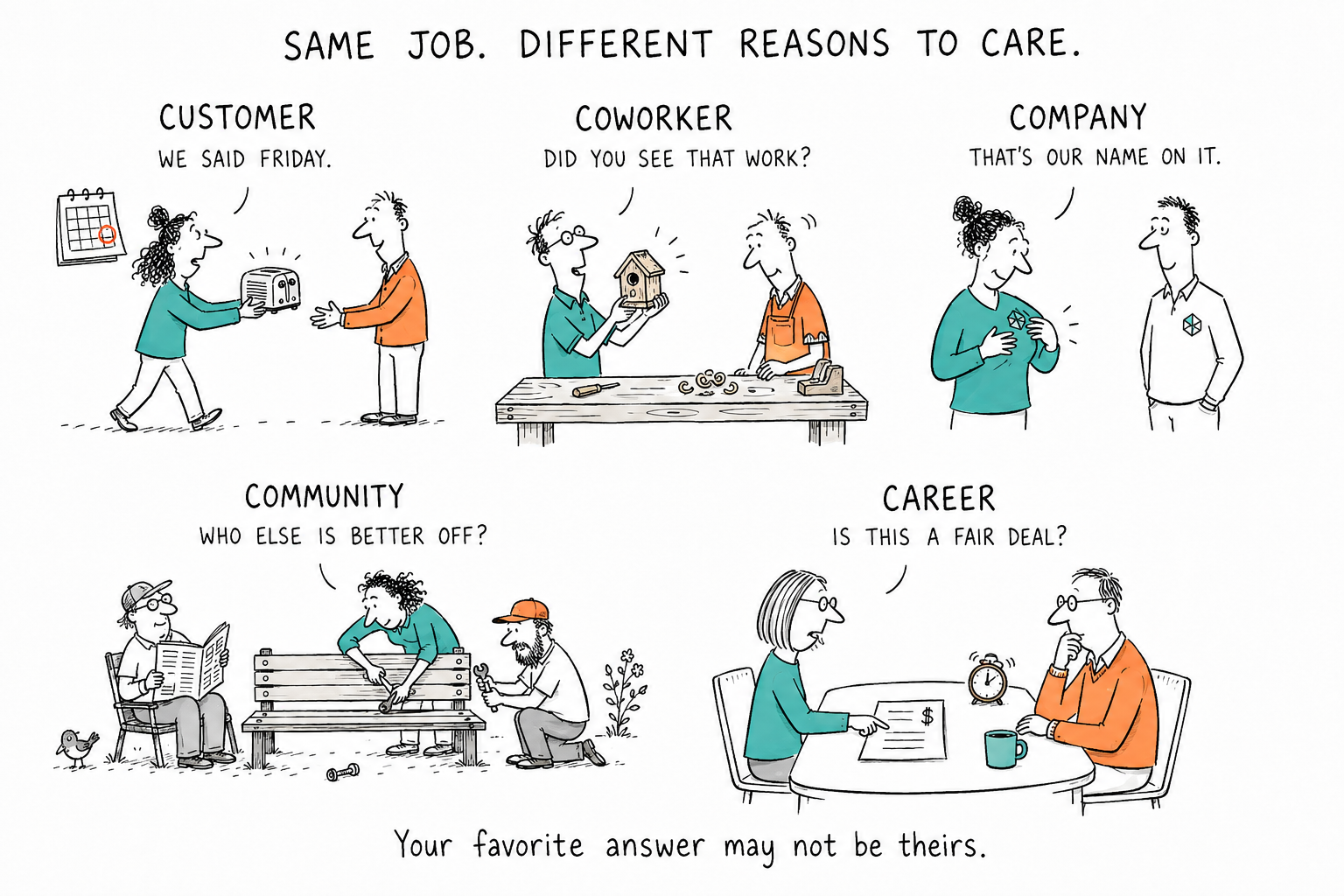
Five questions that help leaders understand what makes work matter to the people doing it.

A person can receive a raise and still feel that the job has become smaller.
Perhaps the work no longer lets her keep the promises she makes to customers. Perhaps the craft she has spent years developing is now treated as an obstacle to volume. Perhaps she is asked to speak proudly about a company whose choices she would rather not explain to her children.
More money may be welcome. It may also leave the actual concern untouched. A leader can make a generous offer and feel bewildered when the other person fails to become appropriately grateful.
The difficulty begins when we assume that what makes the work meaningful to us must be what makes it meaningful to everyone else. Owners have good reasons to care about the company's success. Employees have lives, gifts, and responsibilities that meet the company at different points. Their reasons deserve more attention than a revised version of the owner's speech.
I use five Cs to explore those reasons: Customer, Coworker, Company, Community, and Career. They are a practical adaptation of the meaning-at-work discussion developed by Susie Cranston and Scott Keller. The framework gives us questions to ask about promises and lived experience. It does not give us a score for the human being answering them.
 Open full-size illustration
Read the illustration as text
Same job. Different reasons to care. Customer: a repaired toaster delivered as promised—“We said Friday.” Coworker: a colleague recognizes good craft—“Did you see that work?” Company: people take pride in the organization they represent—“That’s our name on it.” Community: colleagues repair a park bench—“Who else is better off?” Career: a person considers a contract and compensation—“Is this a fair deal?” The closing observation is, “Your favorite answer may not be theirs.” Customer concerns making and keeping the right promises; Coworker concerns recognition of craft and contribution; Company concerns organizational pride; Community concerns contribution beyond the organization; Career concerns contract and recompense. Multiple sources may matter to one person. This is not a numeric assessment or a division of people into equal shares.
Customer: the promise someone gets to keep
For some people, the work comes alive in the promise made to a customer. They want to supply something useful, solve the right problem, and be able to stand behind what they have said. Their satisfaction may be very particular: the machine worked, the appointment was honored, the family understood its options, the product did what the company claimed.
This source of meaning becomes strained when employees are required to promise what the organization cannot deliver. A salesperson who cares about customers may dread a successful sale if fulfillment is unreliable. A service employee may spend a day apologizing for decisions made far from the customer and return home wondering what honesty now requires of her.
A recognition program will have limited value if the recognized person still lacks the authority or resources to keep the promise. Leadership can begin by asking what the customer was led to expect, what the employee is able to provide, and where the gap is being carried.
That conversation belongs to brand work as much as it belongs to operations. A promise acquires its meaning in somebody else's experience.
Coworker: craft that someone can see
Coworker concerns seeing and being seen for excellence and the contribution of craft. There is a particular pleasure in working alongside someone who understands what good work required. A colleague notices the careful judgment, the difficult repair, the elegant solution, or the extra attention that prevented a problem nobody else will ever encounter.
For someone who values this, generic praise can feel oddly lonely. Everyone receives the same cheerful acknowledgment, and the work itself remains unseen. Worse, the person may be promoted away from the craft that matters to them because promotion is the only language the organization has for value.
The leadership question is whether excellence has a witness. Do people have room to practice their craft? Can colleagues learn from one another? Does recognition name an actual contribution, and do the working conditions permit that contribution to continue?
A company does not have to turn every skilled employee into a manager in order to take the skill seriously. It does need a truthful way to recognize what the skill contributes.
Company: a name worth wearing
Company concerns belonging to an organization a person can take pride in. In my shorthand, it is the logo on the golf shirt. The person is glad to be associated with this group and what it stands for.
This can be a powerful good. An organization can carry a shared history, a standard, a reputation for courage or usefulness, and a sense that people have accomplished something together. A company can become a place whose name someone says with affection.
Pride becomes more complicated when loyalty requires silence about a contradiction. The person who wants the company to be worthy of its reputation may be the person raising an unwelcome concern. Treating that concern as disloyalty can damage precisely the relationship the leader hoped to protect.
If Company is important to someone, ask what makes membership honorable in their eyes. Listen for actual choices. A new logo can identify a promise. It has a difficult time repairing one.
Community: where the contribution goes
Community concerns the difference the company and a person's contribution make beyond the company. What becomes possible for other people because this business exists and this work gets done?
An employee may care about the useful product, the way the firm treats a neighborhood, the opportunities it creates, or the people helped by its resources. The relevant good does not have to be spectacular. Reliability, provision, and everyday service can matter considerably to those receiving them.
A leader should ask whether the claimed contribution is visible in practice. If the company celebrates its generosity while disregarding the costs it imposes nearby, an employee may hear a story at odds with the place they know. A charitable photograph cannot resolve that tension.
The practical question is what the contribution means to the people affected. Their accounts may confirm the company's hopes, complicate them, or reveal something the leadership team has missed. That is a reason to listen carefully before turning an account into promotional copy.
Career: an agreement that respects a life
Career concerns contract and recompense. The person supplies work under an agreement and expects the organization to honor its side. Pay matters. So do the actual responsibilities, time commitments, and conditions under which the person is expected to perform.
It is tempting to treat this source of meaning as less noble than the others. That temptation deserves resistance. Providing for a household is consequential. Wanting an honest agreement is reasonable. A person can do excellent work without making the company's ambition the center of their identity.
Purpose language becomes corrosive when it is used to make a fair request sound spiritually or morally small. The employee asking about compensation may be honoring obligations the employer cannot see.
A leader can care about the whole person by keeping the agreement clear and respecting the life it serves.
Listen before improving the offer
These five concerns can overlap. They can change in emphasis as a person's circumstances change. They do not arrive in five equal groups in your organization, and a job title will not tell you which concern is dominant. Neither will your preferred personality framework.
Consider a hypothetical employee offered a higher-paid role that removes her from customer work and gives her responsibility for enforcing a process she distrusts. The company sees advancement. She sees distance from the promise she most wants to keep. The offer deserves an honest conversation before either party decides the other is unreasonable.
Ask for a concrete moment when the work mattered, then a moment when that meaning was frustrated. Stay with what happened. What promise was kept or missed? Who noticed the craft? What made association with the company welcome or difficult? Who benefited beyond the business? What did the agreement make possible in the person's life?
The answer may call for money, a better process, a changed responsibility, recognition, or a candid acknowledgment that this role cannot supply what the person now seeks. Sometimes the generous response is to help someone make a good next decision.
For a Christian leader, these conversations give practical shape to the conviction that people belong to God. We can receive their contribution without trying to acquire the whole person. We can also discover value in the work that our own account of success had left out.
The company may have more to offer than you have been saying. It may have a promise to repair. Either discovery is more useful than asking everyone to borrow your reason for coming to work.
For the fuller exploration, read Meaning Quotient / Five Cs.
Written with AI drafting assistance.